
For decades across the United Arab Emirates, annual statutory audits were largely viewed by small and medium-sized enterprises as an optional administrative formality or a requirement reserved exclusively for Free Zone trade licence renewals and corporate bank loan applications. However, the regulatory enforcement of Federal Decree-Law No. 47 of 2022 on Corporate Tax, coupled with Ministerial Decision No. 82 of 2023 and Ministerial Decision No. 84 of 2025, has permanently transformed annual audits into a high-stakes, legally mandatory compliance pillar. Today, failing to maintain an independent audit not only halts trade licence renewals across Dubai, Ajman, and Abu Dhabi Free Zones, but can instantly strip 0% Qualifying Free Zone Person (QFZP) tax exemptions, triggering retroactive 9% corporate tax liabilities and crippling administrative fines. Navigating these overlapping mandates requires professional, accredited Statutory Audit Services in the UAE.
Under Article 54 of the UAE Corporate Tax Law and Ministerial Decision No. 84 of 2025, every single Qualifying Free Zone Person (QFZP) must prepare and maintain audited financial statements to maintain its 0% corporate tax benefit, regardless of annual turnover. If your Free Zone company generates AED 500,000 or AED 50,000,000, operating without an independent statutory audit results in the automatic loss of your Qualifying status for the entire tax period and the subsequent 4 years.
1. What is a Statutory Audit & Why is it Required in the UAE?
A statutory audit is an independent, legally mandated examination of a company’s financial records, general ledgers, bank transactions, and operational records conducted by a Ministry of Economy-registered external chartered accountant. The primary objective is to deliver an objective, professional opinion on whether the company’s balance sheet, income statement, and cash flow statement present a true and fair view in strict accordance with International Financial Reporting Standards (IFRS).
In the UAE, statutory audits are governed by a triad of regulatory authorities:
- The UAE Commercial Companies Law (Federal Decree-Law No. 32 of 2021): Articles 243 through 249 require all Limited Liability Companies (LLCs) and Joint Stock Companies (PJSC/PrJSC) to appoint one or more licensed auditors annually to inspect company books and report directly to the shareholders at the Annual General Assembly.
- The Federal Tax Authority (FTA): Mandates audited financial statements under Article 54 of Corporate Tax Law for entities exceeding AED 50M turnover and all Free Zone entities claiming 0% tax relief.
- Free Zone Authorities: Major jurisdictions including Ajman Free Zone (AFZA), Dubai Multi Commodities Centre (DMCC), Jebel Ali Free Zone (JAFZA), Dubai Development Authority (DDA), and IFZA mandate annual audited accounts before granting trade licence renewals.
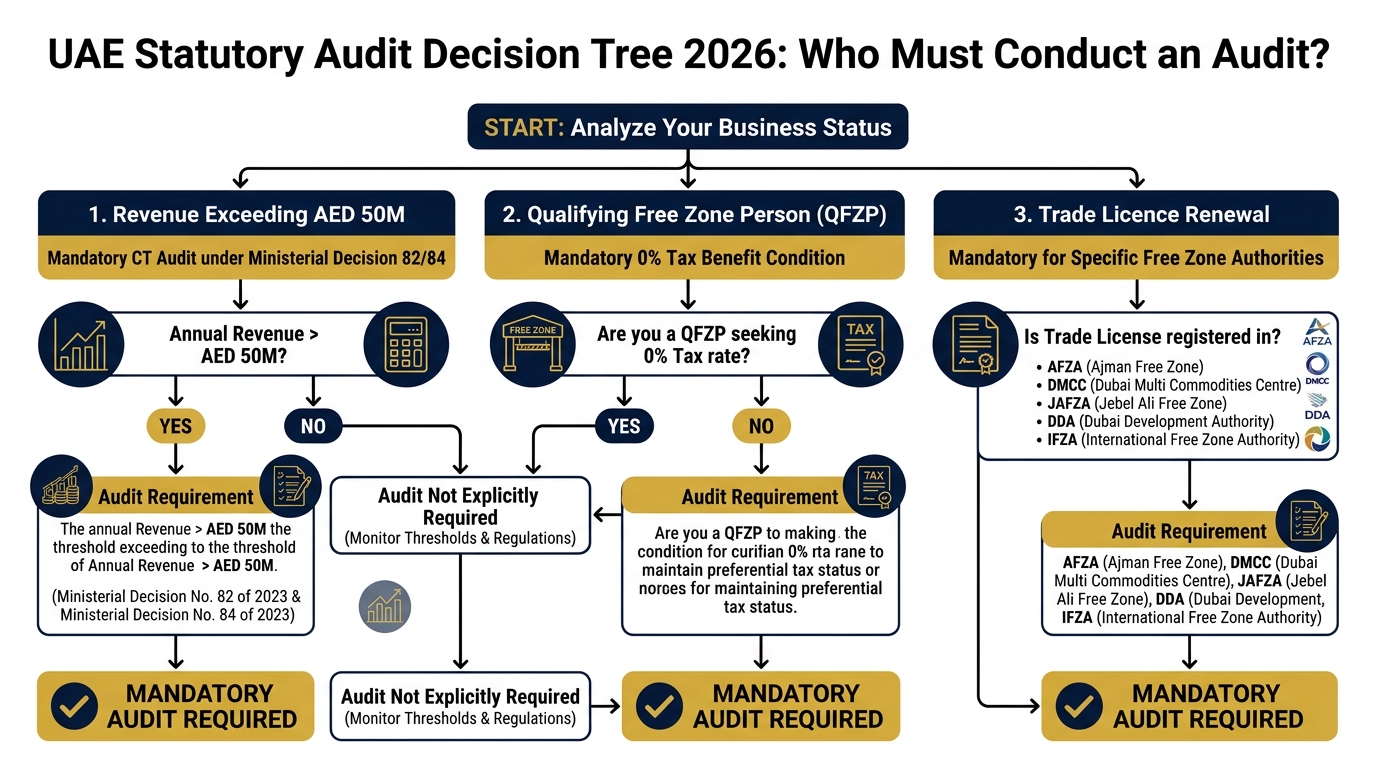
2. Who is Legally Required to Undergo a Statutory Audit in the UAE?
Determining whether your business requires an audit requires examining both your commercial jurisdiction (Mainland vs Free Zone) and your tax classification under the Federal Tax Authority. The mandatory audit criteria are divided into three distinct operational categories:
1
Category A: Corporate Tax Mandate — Revenue Exceeding AED 50,000,000
Under Ministerial Decision No. 82 of 2023 on the Determination of Categories of Taxable Persons Required to Prepare and Maintain Audited Financial Statements, any taxable person (mainland LLC, sole establishment, branch of foreign company, or Free Zone entity opting for standard tax) that derives annual revenue exceeding AED 50,000,000 during the relevant tax period must prepare and maintain audited financial statements. These audited accounts must be prepared in accordance with full IFRS and retained for a minimum of seven (7) years to support Corporate Tax Return Filing.
2
Category B: All Qualifying Free Zone Persons (QFZPs) Seeking 0% Tax
Under Article 18 of Corporate Tax Law and Ministerial Decision No. 84 of 2025, maintaining audited financial statements is one of the strict statutory conditions to qualify as a Qualifying Free Zone Person. Unlike mainland entities, there is NO revenue threshold for QFZPs. Even if a Free Zone enterprise generates only AED 200,000 in qualifying income, it must engage an approved statutory auditor. Failure to prepare audited accounts results in immediate loss of 0% tax treatment, reclassifying the entity as a standard taxable person subject to 9% tax on all profits exceeding AED 375,000. Learn more in our dedicated guide on Free Zone Audit Services in the UAE.
3
Category C: Free Zone Authority Trade Licence Renewal Mandates
Separate from tax obligations, individual Free Zone Authorities exercise statutory power requiring registered companies to submit audited financial reports prior to annual trade licence renewal. Non-submission freezes trade licence validity, halts employee visa issuance, and leads to authority fines. If you are registered in Ajman, review our local guidance on AFZA Approved Audit Services in Ajman.
3. UAE Free Zone Authority Audit Regulations: Comparative Guide
Each UAE Free Zone operates under distinct corporate governance rules. The table below outlines the specific statutory audit mandates, submission deadlines, and approved auditor prerequisites across the most prominent Free Zones:
4. The 5-Phase Statutory Audit Roadmap: From Trial Balance to Final Opinion
An audit is not merely an end-of-year exercise; it is an evidence-based substantive review. A disciplined statutory audit execution follows a structured five-phase roadmap designed to ensure seamless compliance without business disruption:
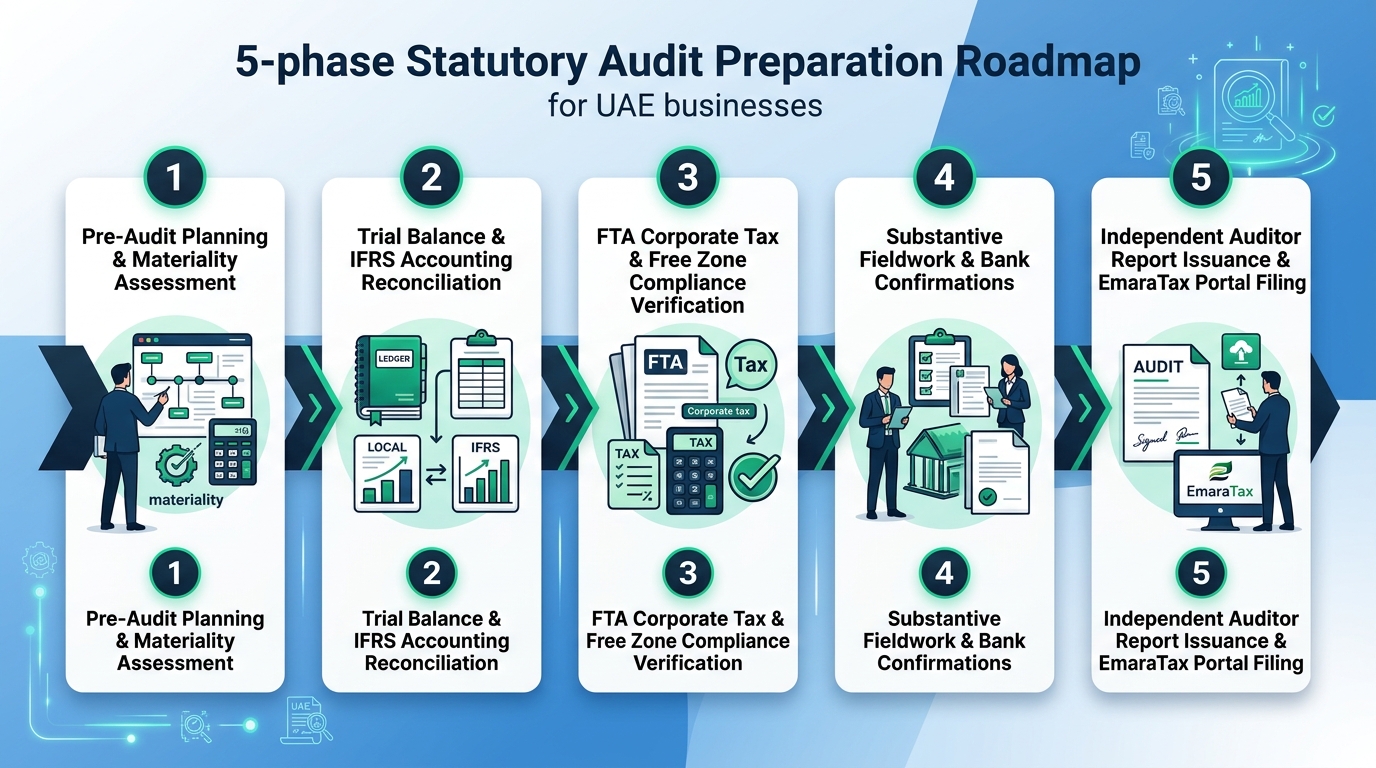
Phase 1: Pre-Audit Planning & Materiality Assessment
The engagement begins with a formal Engagement Letter defining the scope, responsibilities, and applicable accounting framework (IFRS or IFRS for SMEs). The auditor evaluates your internal controls, accounting software (e.g. QuickBooks, Zoho Books, SAP, Xero), and establishes materiality thresholds—the maximum monetary error or omission that could influence the economic decisions of stakeholders.
Phase 2: Trial Balance & IFRS Accounting Reconciliation
Auditors inspect the closing Trial Balance. Adjusting entries are formulated for accrued expenses, prepayments, depreciation schedules, and IFRS 16 lease accounting (capitalizing right-of-use office and warehouse assets). Sub-ledgers for trade receivables and trade payables are matched line by line to verify completeness. Streamline this phase with professional Accounts Payable and Receivable Management.
Phase 3: FTA Corporate Tax & Free Zone Compliance Verification
In 2026, statutory auditors must perform rigorous tax substantive testing:
- Corporate Tax Form CT201 Alignment: Audited net profit is reconciled to taxable income, verifying non-deductible expenses (e.g. 50% entertainment limitation, penalties, exempt income).
- QFZP De Minimis Test: For Free Zone clients, auditors test non-qualifying revenue to ensure it does not exceed 5% of total revenue or AED 5,000,000.
- Transfer Pricing (Article 34): Auditors inspect intercompany management fees, shareholder current accounts, and related-party cross-charges for arm’s length compliance.
Phase 4: Substantive Fieldwork & Third-Party Confirmations
Auditors execute external verification protocols independent of management:
- Direct Bank Confirmations: Auditors request electronic bank confirmation letters directly from UAE financial institutions detailing account balances, credit facilities, bank guarantees, and authorized signatories.
- Accounts Receivable & Payable Circularization: External letters sent to top debtors and creditors confirming balances.
- Physical Inventory Stock Count: Auditors observe year-end physical inventory counting at warehouses to verify asset existence and assess slow-moving or obsolete stock provisions.
Phase 5: Independent Auditor Opinion Issuance & Portal Upload
The audit culminates in the drafting of the Independent Auditor’s Report, complete with full IFRS disclosures, notes to the accounts, and Director’s report. Once signed by a licensed partner, the report is uploaded to the respective Free Zone portal (DMCC, AFZA, JAFZA) and archived within your FTA EmaraTax tax records to support the corporate tax return.
5. Statutory Audit vs FTA Tax Audit vs Internal Audit: Key Differences
Many business owners confuse these three audit disciplines. In the UAE regulatory ecosystem, they serve entirely different masters and serve completely distinct legal functions:
6. Master Statutory Audit Preparation Checklist for UAE CFOs
Delays during an external audit almost invariably stem from missing schedules or un-reconciled intercompany accounts. Prior to welcoming your external auditors, ensure your finance team has compiled the following ten essential workpaper binders:
- Final Signed Trial Balance: Balanced to the exact cent, showing opening balances, period movements, and closing balances mapped to IFRS accounts.
- Complete Bank Reconciliations: Monthly bank reconciliations for every corporate AED and foreign currency account, matched with bank statements up to December 31 / fiscal year end.
- Fixed Asset Register (FAR): Itemized schedule of additions, disposals, and depreciation calculated across all computer equipment, vehicles, machinery, and leasehold improvements.
- Accounts Receivable Aging & IFRS 9 ECL Provision: Detailed customer aging analysis with supporting calculation of the Expected Credit Loss (ECL) allowance under IFRS 9.
- Accounts Payable Aging & Supplier Statements: Vendor aging report reconcilable to major supplier account statements.
- Inventory Valuation & Stock Count Sheets: Final priced inventory list (at lower of cost or net realizable value under IAS 2), accompanied by physically signed count sheets.
- End-of-Service Gratuity (EOSB) Computation: Gratuity liability schedule calculated under UAE Federal Labour Law (Federal Decree-Law No. 33 of 2021) or IAS 19 for each active employee.
- Related-Party Transaction & Loan Agreements: Schedule of all intercompany sales, management charges, and shareholder loans, accompanied by formal signed contracts and transfer pricing policies.
- FTA VAT Return Reconciliations: Quarterly reconciliation comparing Box 1 taxable supplies on VAT201 returns against total revenue reported on the profit and loss ledger.
- Statutory Corporate Documents: Valid trade licence, commercial register, memorandum of association (MOA), tenancy contract (Ejari), and board resolutions.
7. Types of Audit Opinions & Their Commercial Repercussions in the UAE
The ultimate deliverable of your statutory audit is the Independent Auditor’s Report. Understanding the wording in your audit opinion is critical, as banks, Free Zone authorities, and prospective investors interpret these opinions rigorously:
- Unqualified Opinion (Clean Opinion): The auditor concludes that the financial statements present fairly, in all material respects, the financial position and performance of the company in accordance with IFRS. This is the gold standard required for frictionless Free Zone licence renewals, uninterrupted bank borrowing facilities, and seamless FTA corporate tax submissions.
- Qualified Opinion: Issued when the auditor encounters a specific material misstatement or scope limitation that is not pervasive (e.g. unable to attend year-end physical inventory count due to late appointment, or disagreement on the valuation of a specific receivable). Free Zones may accept qualified reports with explanatory letters, but banks frequently tighten borrowing covenants.
- Adverse Opinion: The auditor determines that misstatements are both material and pervasive to the financial statements—meaning the accounts as a whole are misleading. An adverse opinion triggers immediate investigation from Free Zone authorities and leads to bank loan call-backs.
- Disclaimer of Opinion: Issued when the auditor is unable to obtain sufficient appropriate audit evidence to form an opinion (e.g. complete destruction of accounting records, refusal of management to grant access). In the UAE, a disclaimer of opinion is treated virtually the same as non-submission of audited accounts.
Need an AFZA-Approved & FTA-Accredited Statutory Auditor in the UAE?
Don’t risk trade licence renewal freezes or losing your Qualifying Free Zone 0% Corporate Tax exemption. Partner with RBO Accounting Services FZE—official registered statutory auditors and licensed FTA tax agents. We deliver rigorous, IFRS-compliant audit opinions with zero business disruption across Dubai, Ajman, and Abu Dhabi.
8. Frequently Asked Questions (FAQs): UAE Statutory Audits
Is a statutory audit legally mandatory for all UAE mainland companies in 2026?
Under Federal Decree-Law No. 32 of 2021 on Commercial Companies (Articles 243-249), all mainland Joint Stock Companies (PJSC/PrJSC) and Limited Liability Companies (LLCs) are required to appoint an independent licensed auditor and prepare annual audited financial statements. Furthermore, under Federal Decree-Law No. 47 of 2022 on Corporate Tax and Ministerial Decision No. 82 of 2023, any mainland business generating annual revenue exceeding AED 50,000,000 must prepare and maintain audited financial statements for FTA compliance.
Do UAE Free Zone companies with 0% Corporate Tax need an audit even if revenue is below AED 50M?
Yes, absolutely. Under Article 54 of the Corporate Tax Law and Ministerial Decision No. 84 of 2025, maintaining audited financial statements is a mandatory qualifying condition for any Qualifying Free Zone Person (QFZP) seeking to benefit from the 0% preferential corporate tax rate. If a Free Zone company fails to produce an independent auditor report, it automatically loses its QFZP status, becomes subject to the standard 9% corporate tax rate on all taxable income for that year and the subsequent four tax years, and faces severe administrative penalties.
What is the statutory filing deadline for submitting audited accounts in UAE Free Zones?
Statutory audit filing deadlines vary by jurisdiction. For example, DMCC requires audited financial statements within 90 days of the company fiscal year-end via the DMCC Member Portal. JAFZA permits up to 90 days post financial year-end. AFZA (Ajman Free Zone) requires audited accounts submitted prior to annual trade licence renewal. Under UAE Corporate Tax, audited accounts must be ready and retained prior to filing Form CT201, which is strictly due within 9 months following the close of the financial year.
Can any accounting firm sign off on our statutory audit report in the UAE?
No. A statutory audit report can only be signed by an independent registered auditor registered with the UAE Ministry of Economy under Federal Decree-Law No. 20 of 2024. Furthermore, specific Free Zones maintain approved auditor registries. For instance, entities registered in Ajman Free Zone (AFZA), DMCC, or JAFZA must select an auditor officially listed on the authority approved panel, such as RBO Accounting Services FZE.
What accounting framework must be followed for UAE statutory audits?
In accordance with Ministerial Decision No. 114 of 2023, businesses in the UAE must prepare their financial statements using International Financial Reporting Standards (IFRS). Entities with annual revenue not exceeding AED 50,000,000 are permitted to apply IFRS for Small and Medium-sized Entities (IFRS for SMEs), while entities with revenue exceeding AED 50,000,000 must prepare accounts under full IFRS standards.
What is the difference between a Statutory Audit and an FTA Tax Audit?
A Statutory Audit is an independent annual examination conducted by external licensed auditors on behalf of shareholders, banks, and commercial licensing authorities to express an objective opinion on whether the financial statements represent a true and fair view under IFRS. In contrast, an FTA Tax Audit is an official regulatory inspection conducted by Federal Tax Authority officers to verify whether the business correctly computed, reported, and settled its Corporate Tax and VAT liabilities under UAE tax law.
What happens if a UAE company operates without an independent statutory audit?
Operating without a mandated statutory audit exposes the company to severe multi-agency repercussions: Free Zone authorities impose trade licence renewal blocks and fines up to AED 20,000; the FTA can strip Qualifying Free Zone status (reverting to 9% tax) or levy tax assessment penalties; and UAE commercial banks routinely freeze corporate credit facilities, letters of credit, and trade finance lines when audited statements are not supplied within 180 days of year-end.
How long does a statutory audit take from trial balance handoff to final report issuance?
For an SME with clean, reconciled trial balances, bank reconciliations, and supporting ledgers, a statutory audit typically takes between 2 to 4 weeks. For medium-to-large enterprises with multiple subsidiaries, inventory stocktakes, complex related-party transactions, or overseas operations, the audit cycle spans 4 to 8 weeks. Engaging an approved auditor early prevents last-minute trade licence expiry and corporate tax filing bottlenecks.