
For years across Dubai, Abu Dhabi, Ajman, and the Northern Emirates, small and medium-sized enterprises (SMEs) frequently treated accounting as an afterthought—often relying on sporadic bank statements, shoe-box receipts, or unformatted Excel spreadsheets compiled days before trade licence renewal. However, the nationwide enforcement of Federal Decree-Law No. 47 of 2022 on Corporate Tax, backed by Cabinet Decision No. 75 of 2023 and Ministerial Decision No. 114 of 2023, has permanently terminated the era of informal accounting in the United Arab Emirates. Today, every registered commercial entity—regardless of turnover, jurisdiction, or profitability—is under strict federal obligation to maintain standardized books of accounts aligned with IFRS and retain verifiable financial records for a minimum of seven years. Navigating this rigorous compliance ecosystem requires accredited, professional Bookkeeping and Accounting Services in the UAE.
Under Article 56 of the UAE Corporate Tax Law, failure to maintain statutory books of account, trial balances, and supporting documentation attracts immediate administrative fines starting at AED 10,000 for the first offence and AED 20,000 for repeated violations. Furthermore, unsupported business expenses will be disallowed by the Federal Tax Authority (FTA), artificially inflating taxable profits and subjecting your enterprise to retroactive 9% corporate tax assessments and late payment surcharges.
1. The New Legal Reality: Why Accounting is Mandatory for All UAE Businesses
A pervasive misconception among foreign entrepreneurs and local business owners is that companies with revenue under the AED 375,000 Corporate Tax threshold, zero-revenue startups, or Free Zone companies are exempt from maintaining formal books. This is legally incorrect. The requirement to keep books of account is anchored in multiple statutory federal frameworks:
- Federal Decree-Law No. 32 of 2021 on Commercial Companies (CCL): Articles 26 through 30 mandate that every commercial company registered in the UAE must keep accounting records that accurately explain its transactions, disclose its financial position with reasonable accuracy, and prepare annual balance sheets and profit and loss statements.
- Federal Decree-Law No. 47 of 2022 on the Taxation of Corporations and Businesses: Article 56 explicitly requires all taxable persons to prepare and maintain financial statements, ledgers, and underlying source records to substantiate any information submitted in Corporate Tax returns (Form CT201).
- Federal Decree-Law No. 8 of 2017 on Value Added Tax (VAT): Article 78 requires registered businesses to maintain detailed tax invoices, credit notes, import/export declarations, and accounts records for input and output tax reconciliation.
- Free Zone Authority Regulations: Authorities such as Ajman Free Zone (AFZA), DMCC, JAFZA, and DDA mandate verified financial statements to maintain active trade licence status and process annual renewals.
Whether you operate a mainland Limited Liability Company (LLC), a boutique consultancy in a Free Zone, or an e-commerce platform, robust outsourced accounting solutions are no longer discretionary overhead—they are your fundamental legal shield against regulatory shutdowns and punitive tax penalties.
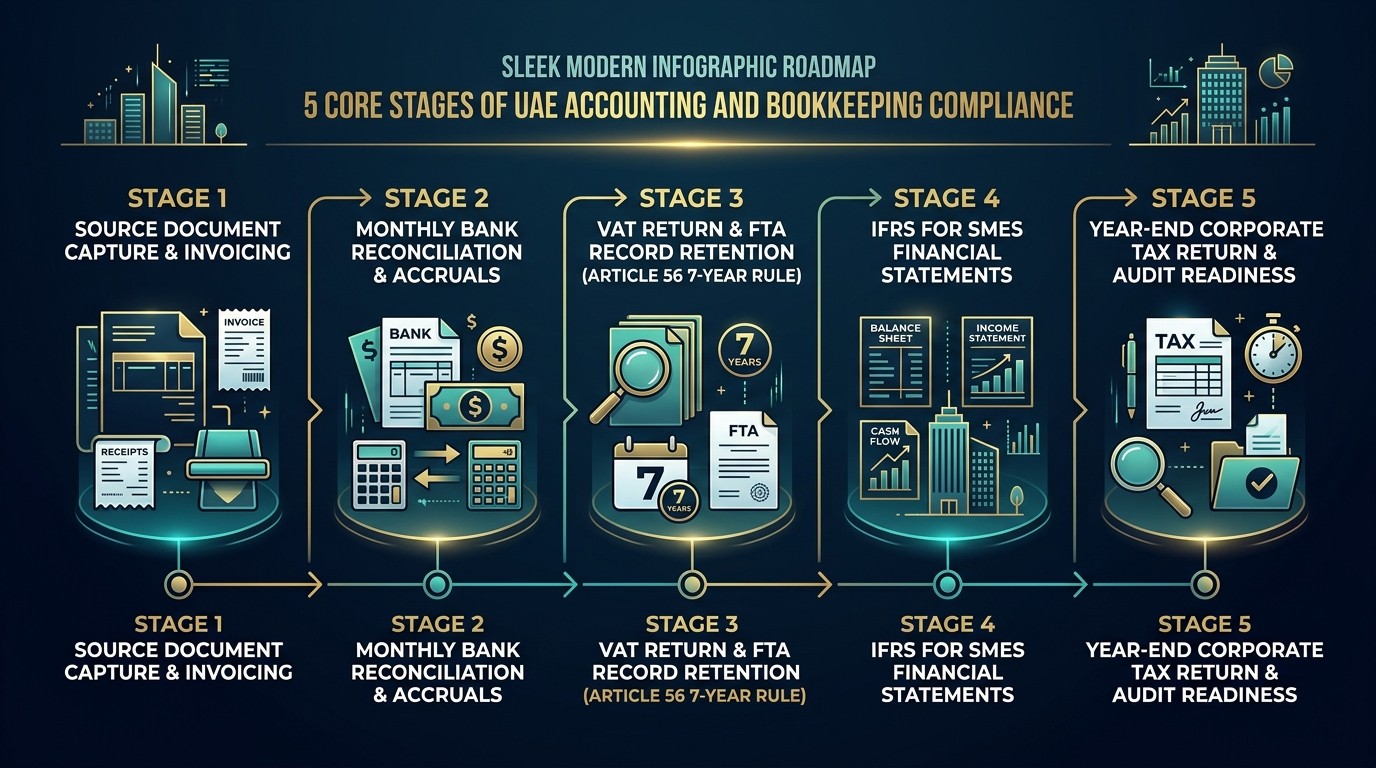
2. Article 56 & The Mandatory 7-Year Document Retention Rule
Under Article 56 of the Corporate Tax Law and Article 78 of the VAT Law, maintaining books is not merely an annual exercise—it is a perpetual preservation mandate. Taxable persons must preserve all accounting records and supporting documents for a statutory period of seven (7) years following the end of the tax period to which they relate.
For companies holding capital assets or real estate in the UAE, the retention requirement extends to fifteen (15) years. The FTA possesses the legal authority to initiate a tax audit at any moment within this statutory window and request immediate access to historical ledgers.
📋 The 7-Year Mandatory Record Retention Checklist
General ledger, general journal, accounts receivable sub-ledger, accounts payable sub-ledger, cash books, and monthly trial balances.
All issued customer tax invoices, received vendor tax invoices, credit notes, and debit notes containing complete mandatory FTA particulars.
Monthly bank account statements, credit card statements, payment gateway settlement logs (Stripe, Network International), and monthly bank reconciliation statements.
Wages Protection System (WPS) salary transfer files (SIF), employment contracts, leave records, and statutory end-of-service gratuity calculation sheets.
Office lease agreements (Ejari/Tawtheeq), supplier master agreements, shareholder resolutions, loan agreements, and intercompany transfer pricing agreements.
Customs import/export declarations, bills of lading, physical stocktake count sheets, inventory valuation reports, and asset disposal registers.
3. IFRS vs IFRS for SMEs: Which Accounting Standard Applies to You?
Under Ministerial Decision No. 114 of 2023 on the Accounting Standards and Methods for the Purposes of the Corporate Tax Law, the UAE Ministry of Finance established that all financial statements must be prepared in accordance with International Financial Reporting Standards (IFRS).
Recognizing that full IFRS places an unsustainable compliance burden on growing businesses, the Ministry established a clear tier structure:
Applying the appropriate standard prevents both non-compliance fines and unnecessary accounting expenditure. Our certified team delivers tailored IFRS Compliance Services to ensure your financial statements withstand the most rigorous scrutiny from external auditors and tax examiners.
4. Accrual Accounting vs Cash Basis: The AED 3 Million Threshold
Under Ministerial Decision No. 114 of 2023, the Ministry of Finance made an important concession for micro-businesses: entities whose annual revenue does not exceed AED 3,000,000 may elect to maintain their books using Cash-Basis Accounting.
The moment your business turnover reaches AED 3,000,001 within a tax period, Accrual-Basis Accounting becomes legally mandatory. Under the accrual method, revenue must be recognized when earned and expenses when incurred—regardless of cash movement. Implementing professional Accounts Payable and Accounts Receivable Management ensures your accruals, deferrals, and prepayments match statutory tax guidelines.
5. The 5 Critical Bookkeeping Errors That Trigger FTA Tax Audits
1. Commingling Personal & Corporate Funds
Using the corporate credit card for personal family groceries or school fees is non-deductible under Corporate Tax rules. Mixing personal expenses into general expense accounts without classification in a director loan account leads the FTA to disqualify deductions and impose surcharges.
2. Discrepancies Between VAT Returns and Corporate Tax Revenue
The FTA cross-references total standard-rated, zero-rated, and exempt supplies reported across your four quarterly VAT returns against gross revenue declared on Form CT201. Unexplained variances trigger automated audit notifications.
3. Unreconciled Bank Balances and Round-Figure Cash Withdrawals
A general ledger balance that does not tie out to the penny with the monthly bank statement is an immediate audit failure. Unsubstantiated cash withdrawals from corporate ATMs are flagged as fictitious claims unless supported by tax invoices.
4. Failure to Apply the 50% Entertainment Expense Restriction
Under Article 32 of the Corporate Tax Law, customer and partner entertainment expenses are only 50% tax-deductible. Failing to add back the disallowed 50% portion results in underpayment of corporate tax.
5. Omitting Statutory End-of-Service Gratuity on the Balance Sheet
Under UAE Labour Law and IFRS, businesses must accrue an ongoing monthly provision for employee End-of-Service Benefits (EOSB). Treating severance as an expense only when staff resigns violates accrual accounting rules.
6. In-House Accountant vs Outsourced Accounting Firm: 2026 Cost & Risk Comparison
7. The RBO 30-Day Month-End Financial Close Protocol
All customer invoices, supplier bills, customs import documents, and expense receipts are captured via secure cloud portals and verified for FTA compliance.
Every bank transaction across corporate accounts, payment processors (Stripe, Network International), and petty cash is reconciled line-by-line.
Recording journal entries for rent prepayments, unbilled revenue, fixed asset depreciation, and reconciling WPS payroll files.
A senior manager verifies tax mapping across VAT Box 1 through 12, ensures 50% entertainment expense add-backs, and locks monthly accounting periods.
Business owners receive high-impact Financial Reporting and Management Accounts, including Profit & Loss, Balance Sheet, and Cash Flow forecasts.
8. How Accurate Bookkeeping Protects Your Corporate Tax & Audit Readiness
Clean bookkeeping is the direct foundation upon which your Corporate Tax Return Filing and annual Statutory Audit rely.
When monthly accounts are kept pristine, the year-end statutory audit becomes a seamless, stress-free milestone. Approved auditors can swiftly verify opening balances, test sample invoices, and issue clean, unqualified audit reports needed for Free Zone trade licence renewal and banking facilities without delay.
Upgrade Your UAE Bookkeeping to Institutional Standards
Stop risking AED 20,000+ FTA administrative fines and rejected tax deductions. Partner with RBO Accounting Services to secure meticulous monthly bookkeeping, seamless VAT and Corporate Tax compliance, and strategic financial clarity at a fraction of the cost of an in-house hire.