
For decades, setting up a business in a UAE Free Zone—whether in Dubai Multi Commodities Centre (DMCC), Jebel Ali Free Zone (JAFZA), Dubai Airport Freezone (DAFZA), Ajman Free Zone (AFZA), or Abu Dhabi Global Market (ADGM)—guaranteed a 0% tax environment. However, under Federal Decree-Law No. 47 of 2022 on the Taxation of Corporations and Businesses and subsequent implementing decisions, the widespread assumption that “all free zone companies automatically pay zero tax” is not only incorrect—it is dangerously expensive.
1. The 6 Mandatory Conditions to Become a Qualifying Free Zone Person (QFZP)
Article 18 of the Corporate Tax Law, reinforced by Cabinet Decision No. 139 of 2023 and Ministerial Decision No. 265 of 2023, establishes that a Free Zone entity must cumulatively satisfy all six of the following criteria in every financial year:
- ✓ 1. Maintain Adequate Substance in the UAE: Undertake Core Income-Generating Activities (CIGA) within a Free Zone, possessing adequate physical assets, qualified full-time personnel, and operational expenditure proportionate to activity levels.
- ✓ 2. Derive Qualifying Income: Generate revenues strictly from defined Qualifying Activities or eligible transactions with other Free Zone persons.
- ✓ 3. Not Elect to Be Subject to Standard 9% Tax: Must not have formally opted out of QFZP status via EmaraTax.
- ✓ 4. Comply with Transfer Pricing (Articles 34 & 55): Maintain arm’s-length intercompany pricing, transfer pricing documentation (Local File & Master File where applicable), and related-party disclosure schedules.
- ✓ 5. Prepare Mandatory Audited Financial Statements: Regardless of turnover, every QFZP must have its annual accounts audited by an approved UAE auditor according to IFRS standards.
- ✓ 6. Satisfy the De Minimis Requirement: Ensure non-qualifying revenue does not exceed statutory caps (5% of total revenue or AED 5,000,000, whichever is lower).
2. Qualifying Income vs. Non-Qualifying Income: Where the Line is Drawn
Understanding how your contracts and client invoices are categorized determines whether your profits are taxed at 0% or 9%. The FTA categorizes corporate income into three distinct operational streams:
A. Transactions with Other Free Zone Persons (0% Rate)
Revenues derived from transactions with other Free Zone entities are considered Qualifying Income (0%), provided the transaction does not involve any Excluded Activities. The beneficial recipient must be a Free Zone entity, and the goods or services must be consumed within a Free Zone or designated zone.
B. Transactions with Non-Free Zone Persons (Mainland UAE & International)
If your Free Zone company sells to mainland UAE businesses or foreign international clients, that revenue is only Qualifying Income if it falls strictly within the prescribed list of Qualifying Activities under Cabinet Decision No. 139 of 2023:
- Manufacturing & Processing: Processing of goods, assembly, and industrial manufacturing inside a Free Zone.
- Holding of Shares & Securities: Holding equity interests, shares, and investment assets for investment purposes.
- Ship Ownership & Operations: Commercial operation of ships in international traffic, chartering, and maritime logistics.
- Reinsurance & Wealth Management: Regulated reinsurance services and asset/fund management services under DFSA, FSRA, or SCA.
- Headquarter & Treasury Services: Providing centralized management, procurement, or treasury services to related parties.
- Logistics Services: Cargo handling, freight forwarding, warehousing, and inventory storage.
- Distribution of Goods in or from a Designated Zone: Wholesale distribution and trading where goods physically pass through or are stored within a Designated Free Zone (e.g., JAFZA, DAFZA, KIZAD, HFZA).
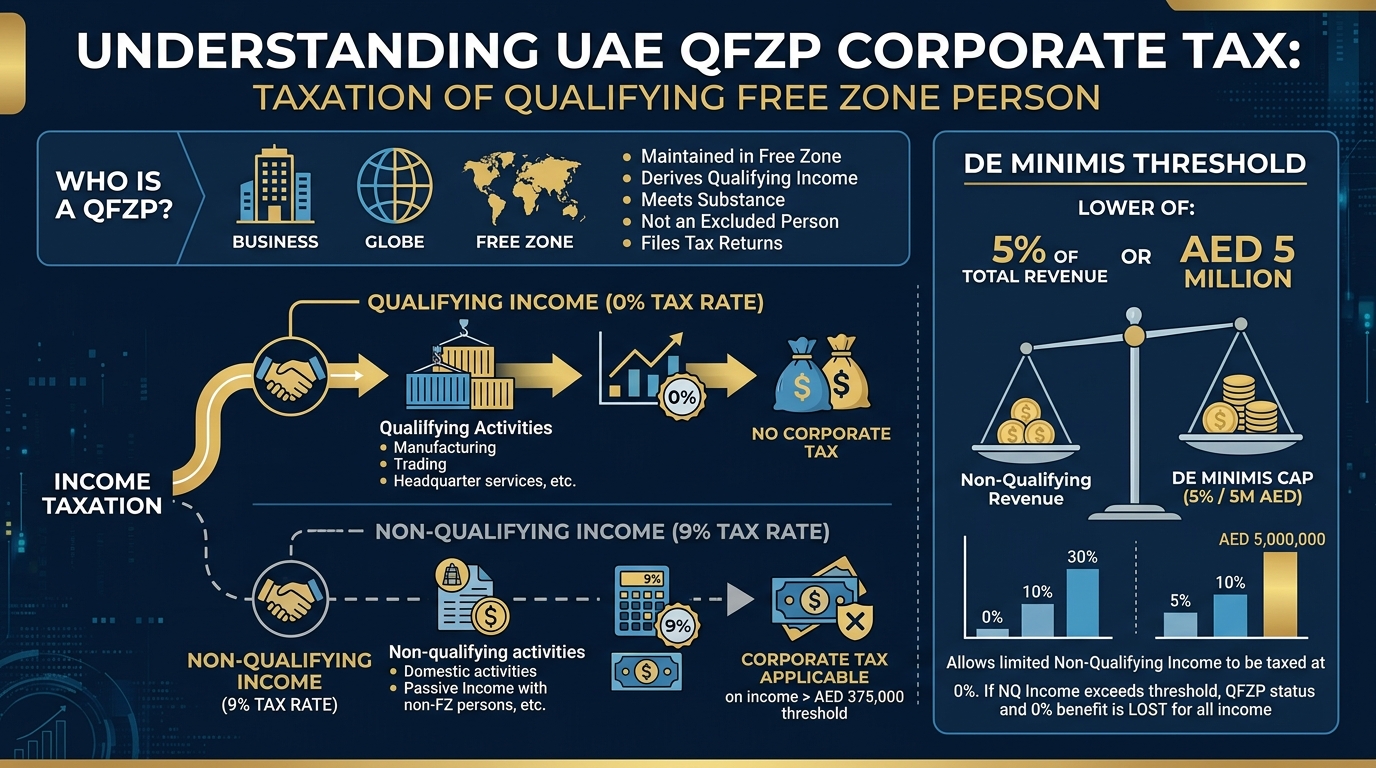
C. Excluded Activities (Always Subject to 9% Tax)
If your Free Zone entity performs any of the following activities, the revenue earned is automatically Non-Qualifying Revenue:
- Transactions with Natural Persons (B2C): Retail sales, direct consulting to individuals, or retail e-commerce directly to consumers.
- Regulated Banking & Insurance Activities: Traditional commercial banking, consumer lending, and direct retail insurance.
- Ownership & Exploitation of Intellectual Property (IP): Royalties, software licenses, patents, and trademark licensing fees (unless Qualifying IP relief applies under OECD BEPS Nexus guidelines).
- Immovable Property in Free Zones: Commercial transactions involving real estate with non-Free Zone persons, or any residential property operations.
3. The De Minimis Rule: Real-World Calculation & Danger Zones
The UAE Ministry of Finance recognized that a Free Zone entity might inadvertently generate small incidental amounts of non-qualifying income. To prevent immediate tax penalties for minor transgressions, the De Minimis Rule acts as a statutory safety net.
Non-Qualifying Revenue must NOT exceed:
If your non-qualifying revenue remains within this limit, your Qualifying Income is taxed at 0%, and the non-qualifying portion is taxed at 9% (above the AED 375,000 threshold).
Worked Practical Examples:
| Metric / Company | Company A (Compliant) | Company B (Breached) |
|---|---|---|
| Total Annual Turnover | AED 20,000,000 | AED 12,000,000 |
| De Minimis Ceiling (Lower of 5% or 5M) | AED 1,000,000 (5% of 20M) | AED 600,000 (5% of 12M) |
| Actual Non-Qualifying Revenue | AED 800,000 (4.0%) | AED 900,000 (7.5%) |
| De Minimis Compliance Result | PASSED ✓ | FAILED ✗ (Breached) |
| Tax Rate Applied | 0% on AED 19.2M Qualifying; 9% on AED 800k | 9% on entire AED 12,000,000 net profit! |
4. The 5-Year Disqualification Penalty Look-Through Rule
The most severe consequence under UAE Corporate Tax law is the 5-year disqualification penalty. If your Free Zone company breaches the De Minimis threshold or fails to satisfy any of the other five core criteria (such as failing to produce audited financial statements):
Under Article 18(4) of the Corporate Tax Law, the entity loses its Qualifying Free Zone Person status not only for the tax year of the breach, but also for the subsequent four tax periods. For five consecutive years, 100% of the entity’s taxable profits will be taxed at the full 9% mainland rate.
5. Mandatory Audited Financial Statements: No Exemptions for Free Zones
Under mainland Corporate Tax rules, businesses with turnover below AED 50,000,000 or those electing for Small Business Relief (SBR) are often exempt from submitting audited accounts with the FTA. This exemption does NOT apply to Qualifying Free Zone Persons.
Every QFZP—even a boutique consulting firm in AFZA or a two-person trading outfit in DMCC—must have its annual financial statements audited by a Ministry of Economy-licensed UAE auditor. Filing Form CT201 without an audit report will automatically disqualify you from QFZP status and trigger the 5-year penalty.
As licensed chartered accountants and approved auditors across Dubai, Abu Dhabi, and Northern Emirates free zones, RBO Accounting Services FZE provides comprehensive statutory audit dossiers fully aligned with IFRS and FTA compliance requirements.
6. Strategic Action Plan: How Free Zone Companies Can Protect 0% Tax
- Dual-Entity Structuring: If you conduct substantial domestic business with mainland UAE customers, establish a separate mainland LLC or branch to capture mainland revenues, isolating your Free Zone entity’s Qualifying Income from De Minimis contamination.
- Contract Review & Segregation: Audit client contracts to clearly demarcate qualifying distribution or manufacturing services from excluded commercial support or IP licensing.
- Monthly Substance & CIGA Monitoring: Ensure payroll is processed via UAE WPS, commercial office leases are maintained, and executive decision-making is documented in local board minutes.
- Mid-Year De Minimis Tracking: Track monthly revenue streams through Virtual CFO management reporting to ensure non-qualifying sales never cross the 5% threshold.
Protect Your 0% Free Zone Tax Status with RBO
Our FTA-registered tax agents and chartered accountants conduct comprehensive QFZP health checks, audit compliance reviews, and De Minimis stress testing for Free Zone enterprises across Dubai and the UAE.