
If your UAE business is growing, VAT registration is one of the first Federal Tax Authority (FTA) obligations you need to get right. Miss the threshold, wait too long, or file with incomplete records, and you can face a late-registration penalty plus output tax backdated to the effective date.
This guide explains the 2026 VAT registration rules in plain language: the AED 375,000 and AED 187,500 thresholds, who must apply, what documents to prepare, and what happens after you receive a Tax Registration Number (TRN).
Need the registration handled for you? See our VAT registration and filing services.
What is VAT registration in the UAE?
UAE VAT is a 5% tax on most goods and services. Registration means the FTA issues a TRN, you charge VAT on taxable supplies (where required), recover eligible input VAT, and file returns on EmaraTax.
Registration is not the same as corporate tax registration. A company can be required to register for corporate tax even if it is still below the VAT threshold – and the opposite can also be true for some trading or import-heavy businesses.
VAT registration thresholds in 2026
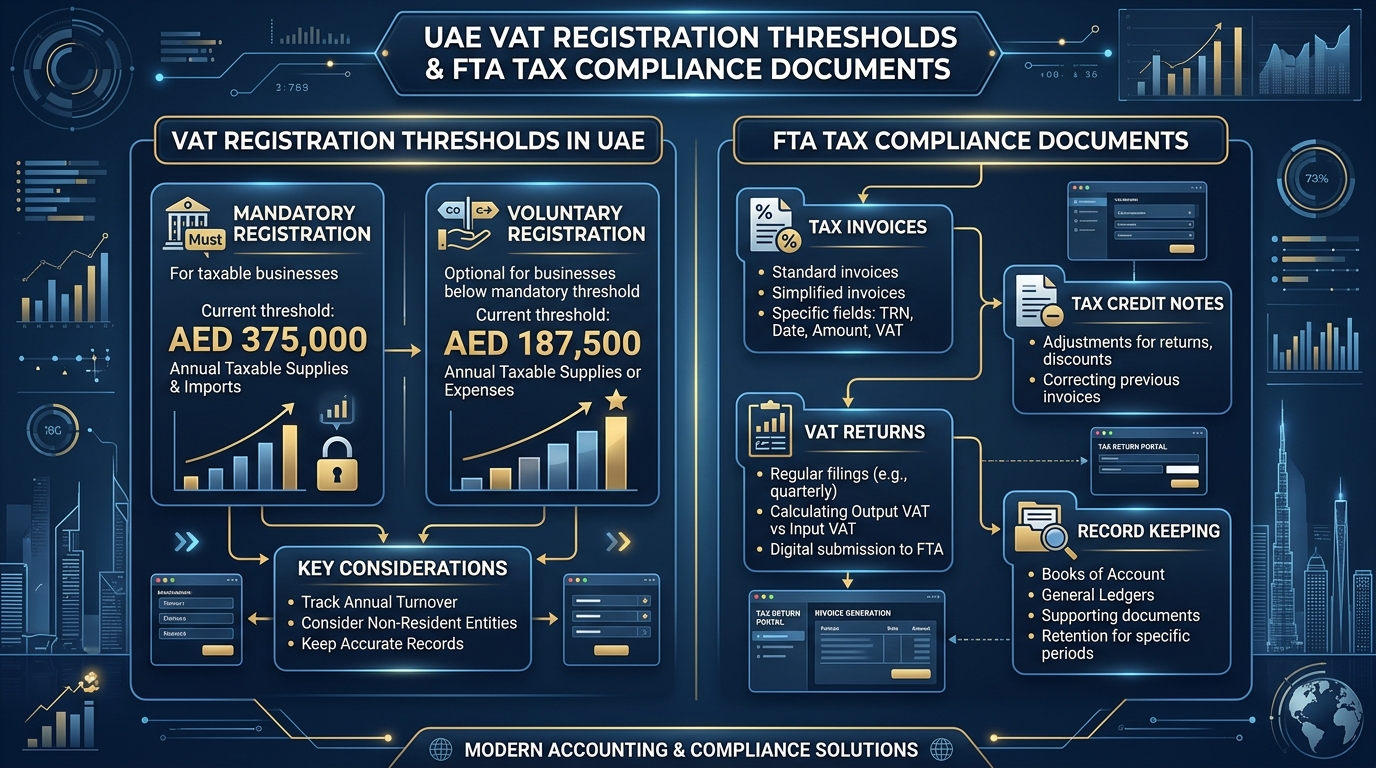
Infographic: UAE VAT Registration Thresholds (AED 375,000 Mandatory vs AED 187,500 Voluntary) & FTA Compliance Workflow
The FTA still uses two thresholds. Both are measured on taxable supplies and imports, not on “profit”.
| Type | Threshold | When it applies |
|---|---|---|
| Mandatory registration | AED 375,000 | Taxable supplies and imports exceeded this in the last 12 months, or you expect to exceed it in the next 30 days |
| Voluntary registration | AED 187,500 | Taxable supplies and imports or taxable expenses meet this test for the last 12 months, or you expect to meet it in the next 30 days |
Who does not get the AED 375,000 threshold?
The mandatory threshold does not apply in the same way to certain non-resident businesses making taxable supplies in the UAE. If you are a foreign supplier with no UAE establishment, get advice before assuming you can wait until AED 375,000.
When must you apply?
Once you are required to register, the application is generally due within 30 days. The FTA decides the effective registration date. That date can be earlier than the day your TRN is approved, which is why late applications are expensive: you may owe VAT on supplies already made.
The current administrative penalty for failing to submit a required VAT registration application is AED 10,000. Additional penalties can apply if returns or payments are then late.
Documents you typically need for EmaraTax
Exact screens change, but most UAE mainland and free-zone applications ask for:
- Trade licence and incorporation documents
- Emirates ID / passport copies for authorised signatories
- Memorandum or articles, and proof of authorised signatory
- Bank account details in the business name
- Business address evidence (Ejari, tenancy, or free-zone confirmation)
- A short description of activities and expected supplies
- Recent financials, invoices, or contracts that support the threshold test
RBO prepares and files this as part of VAT registration, including EmaraTax follow-up if the FTA asks for extra evidence.
Free zone companies still need to check VAT
“Free zone” does not mean “no VAT”. Designated zones have special goods rules. Services, mainland customers, and many e-commerce flows are still taxable. If you sell from DMCC, IFZA, RAKEZ, SHAMS, or similar, map each supply before you decide you are below the threshold.
What happens after you get a TRN
- Put the TRN on tax invoices in the FTA format.
- Decide whether listed prices are VAT-inclusive or exclusive – then stay consistent.
- Configure Xero, Zoho Books, or QuickBooks with the correct tax codes.
- Keep valid tax invoices so input VAT is recoverable.
- Note the tax periods the FTA assigns (often quarterly for SMEs).
- File and pay by the due date shown on EmaraTax. See VAT return filing.
Clean bookkeeping is what makes the first return straightforward. Most first-return problems come from mixed-up bank feeds, missing bills, and invoices issued without a TRN after the effective date.
Voluntary registration: when it is worth it
Registering early can make sense if you:
- Buy significant taxable goods or services and want to recover input VAT
- Tender for clients who will only pay a VAT-registered supplier
- Expect to cross AED 375,000 within a few months and want systems ready
It is less useful if almost all of your costs are exempt or out of scope, or if your customers are consumers who will feel the 5% immediately. Run the numbers before you apply.
Common mistakes we see in UAE VAT registrations
- Counting all bank deposits as “taxable supplies” (loans, owner funds, and some reimbursements are not)
- Ignoring imports when testing the threshold
- Waiting for year-end instead of watching the rolling 12 months
- Issuing invoices after the effective date without a TRN
- Assuming a free-zone licence automatically removes VAT
VAT registration vs corporate tax: do not mix the two
VAT is a transaction tax. Corporate tax is a profit tax. You can need both. If your financial year ended 31 December 2025, the corporate tax return and payment are generally due by 30 September 2026. Read our companion guide: UAE corporate tax 2026 – registration, rates, and the 30 September deadline.
Frequently asked questions
What is the VAT registration threshold in the UAE in 2026?
Mandatory registration is AED 375,000 of taxable supplies and imports. Voluntary registration is available from AED 187,500 of taxable supplies and imports or taxable expenses.
How long does FTA VAT registration take?
Complete applications often clear in a few working days, but the FTA can request extra documents. Build in time before you start issuing customer invoices that must show a TRN.
Can RBO register my company for VAT?
Yes. RBO Accounting Services FZE is an FTA-registered tax agent. We handle the EmaraTax application, threshold review, and ongoing VAT filing across all seven emirates.
What if I already passed the threshold and did not register?
Apply as soon as possible, reconstruct supplies from the date you became required to register, and budget for the AED 10,000 late-registration penalty plus any output VAT due. Do not ignore EmaraTax notices.
Not sure if you have crossed AED 375,000?
Send us your last 12 months of invoices or bank summaries. We will tell you whether registration is mandatory, voluntary, or not yet required – and file it if you are ready.
This article is general information for UAE businesses as of September 2026. It is not tax advice. Confirm your position against FTA guidance or speak to a registered tax agent.