
As UAE businesses navigate corporate tax filing cycles under Federal Decree-Law No. 47 of 2022 on the Taxation of Corporations and Businesses, one compliance domain has emerged as the single highest-risk trigger for Federal Tax Authority (FTA) audits and tax adjustments: Transfer Pricing (TP). A widespread misconception among UAE business owners is that transfer pricing rules apply only to giant multinational corporations moving billions across international borders. In reality, under Articles 34, 35, 36, and 55 of the UAE Corporate Tax Law and Ministerial Decision No. 97 of 2023, every single UAE company—including family-owned groups, mainland LLCs with Free Zone sister entities, and SMEs paying salaries or management fees to their shareholders—is legally bound by the Arm’s Length Principle. Protecting your corporate deductions and 0% Free Zone exemptions requires proactive, audit-proof Transfer Pricing Services in the UAE.
Even if your company has zero international subsidiaries and your revenue is well below the AED 200 million Local File threshold, Article 36 (Payments to Connected Persons) directly targets SMEs. If the aggregate salaries, bonuses, housing allowances, personal expenses, or management fees paid to any shareholder, director, or officer exceed AED 500,000 in a tax period, you must report them on the EmaraTax Transfer Pricing Disclosure Schedule and prove via market benchmarking that the compensation matches the fair market value of their duties. Any excess is disallowed as a tax deduction and taxed at 9%.
1. What is Transfer Pricing & Why Does the UAE Enforce It?
Transfer Pricing refers to the terms, conditions, and prices charged for commercial or financial transactions—such as the sale of goods, provision of management services, intercompany loans, royalty licensing, or cost-sharing arrangements—between Related Parties (associated enterprises under common ownership or control) and Connected Persons (owners, directors, officers, and their relatives).
Without strict transfer pricing legislation, corporate groups could artificially shift profits out of standard 9%-taxed UAE Mainland companies into 0%-taxed Free Zone entities, tax-exempt entities, or low-tax foreign jurisdictions—or drain company profits through inflated shareholder salaries to wipe out corporate tax liability. To prevent base erosion and profit shifting (aligned with the OECD BEPS Action 13 Framework and the official FTA Transfer Pricing Guide CTGTP1), the UAE mandates that all controlled transactions be priced as if they were conducted between two completely independent parties negotiating in an open market: the Arm’s Length Principle (Article 34).
🏛️ The 4 Legal Pillars of UAE Transfer Pricing
- Article 34 (Arm’s Length Principle): Mandates that transactions between Related Parties must reflect the financial results that would have been realized by independent businesses in comparable circumstances.
- Article 35 (Related Parties & Control): Defines Related Parties as two or more natural or giuridical persons connected by 50% or more direct/indirect ownership, voting rights, profit entitlement, or Significant Influence / Effective Control (such as board control, debt dependency, or exclusive supply dependency).
- Article 36 (Payments to Connected Persons): Restricts tax deductibility for payments or benefits provided to owners, directors, officers, and relatives up to the fourth degree of kinship strictly to their verifiable Arm’s Length market value.
- Article 55 & Ministerial Decision No. 97 of 2023 (TP Documentation): Establishes the three-tiered documentation architecture: the Transfer Pricing Disclosure Form (TPDF) in Form CT201, the entity-level Local File, and the group-level Master File.
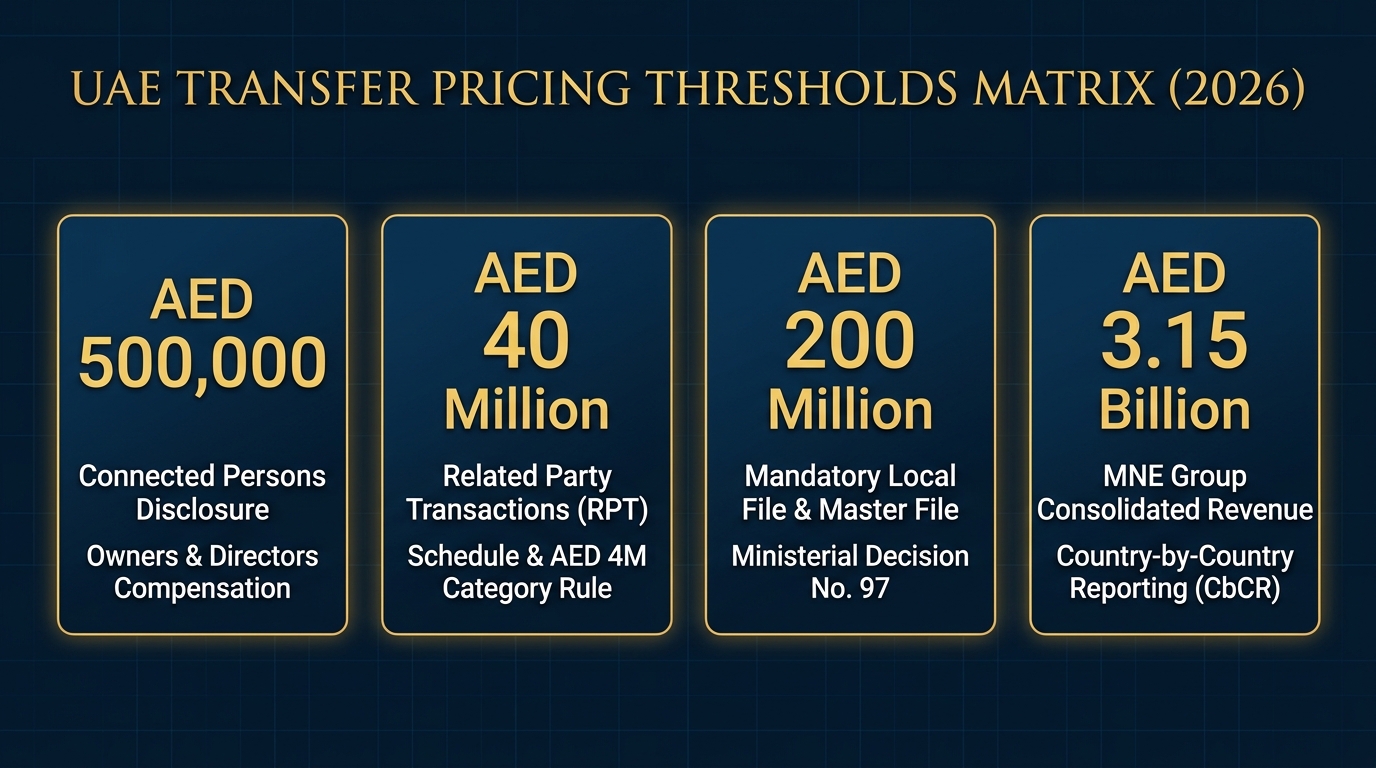
2. Complete Breakdown of the 4 UAE Transfer Pricing Thresholds (2026 Matrix)
Competitor guides often confuse the thresholds for maintaining a Local/Master File with the much lower thresholds for reporting transactions on the EmaraTax Corporate Tax Return (Form CT201). Below is the definitive 2026 regulatory matrix:
3. Related Parties vs. Connected Persons: Understanding the Legal Distinction
Under UAE Corporate Tax Law, the FTA distinguishes sharply between corporate/group relationships (Related Parties) and individual management/ownership relationships (Connected Persons). Failing to map both accurately in your IFRS Accounting & Bookkeeping Ledgers is the number one cause of erroneous Form CT201 filings.
🏢 Related Parties (Article 35)
Focuses on inter-entity control, group structures, and ownership links:
- Two or more individuals related up to the fourth degree of kinship or affiliation (including adoption/guardianship).
- A natural person or legal entity holding 50% or more direct or indirect ownership, voting rights, or profit share in a company.
- Two or more legal entities where a third person holds 50% or more ownership or control in each (sister companies).
- A company and its Permanent Establishment (PE) or foreign branch.
- Partners in the same Unincorporated Partnership, and trustees/founders/beneficiaries of a trust or foundation.
- Control via Significant Influence: Even with less than 50% shares, an entity is a Related Party if it appoints ≥50% of the board, receives ≥50% of profits, supplies essential IP/capital, or dictates commercial pricing.
👔 Connected Persons (Article 36)
Specifically prevents business owners and executives from extracting untaxed profits disguised as deductible salaries or fees:
- An individual who directly or indirectly owns an ownership interest (even 1%) in, or controls, the Taxable Person.
- A Director or Officer of the Taxable Person (Managing Director, CEO, CFO, General Manager named on the Trade Licence or MOA).
- Any individual related to the owner, director, or officer up to the fourth degree of kinship (parents, spouse, children, siblings, grandparents, uncles, aunts, first cousins, and in-laws).
- Any other legal entity in which any of the above persons is a Related Party (e.g., a consultancy Free Zone company owned by the mainland company’s Managing Director).
4. The 5 FTA-Approved Transfer Pricing Methods Explained
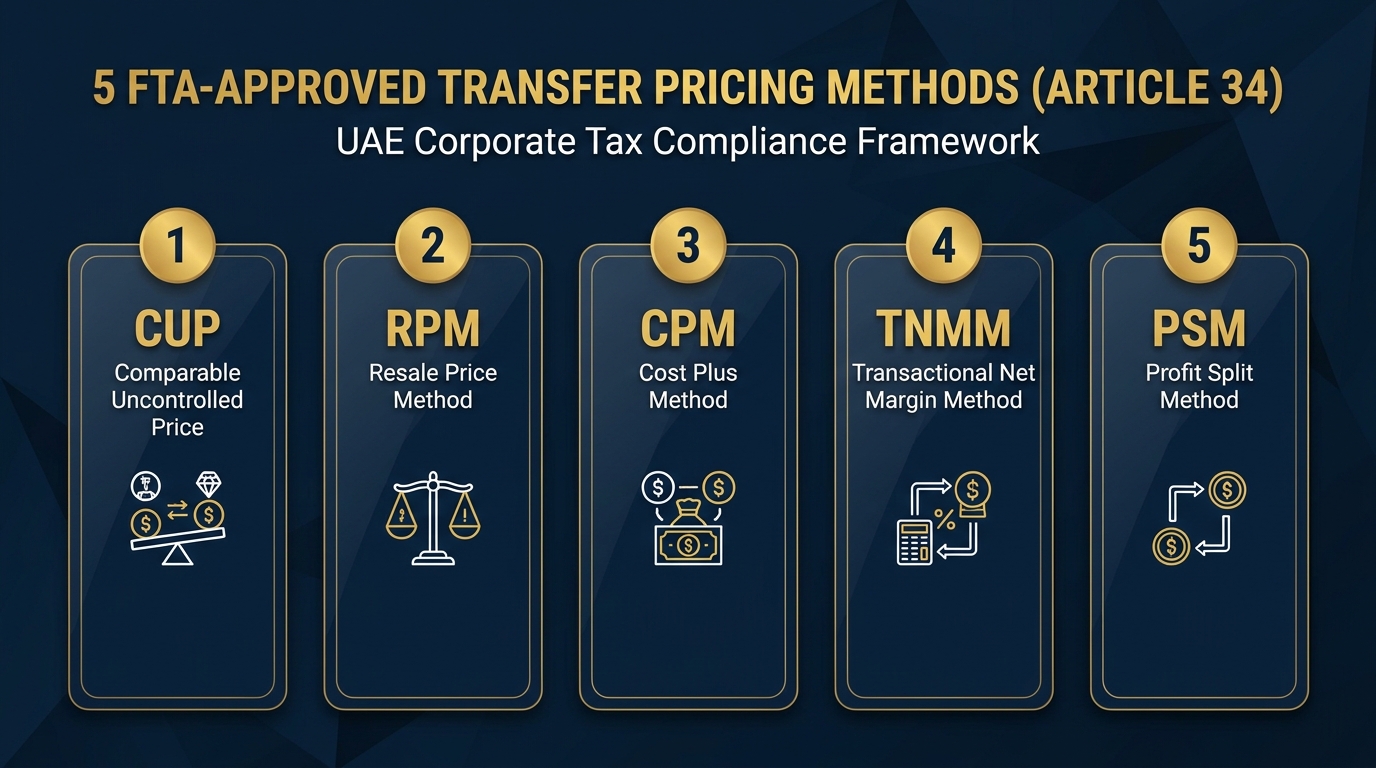
How do you prove to an FTA tax auditor that your intercompany service fee, goods markup, shareholder salary, or intercompany loan interest rate is at “Arm’s Length”? Under Article 34(3) of the Corporate Tax Law, businesses must apply one (or a combination) of five internationally recognized OECD transfer pricing methods, supported by a Functional Analysis (Functions, Assets, and Risks — FAR):
5. Deep Dive: Ministerial Decision No. 97 of 2023 (Local File vs. Master File)
When a UAE entity reaches AED 200 million in annual revenue (or belongs to an MNE group with AED 3.15 billion consolidated revenue), it must maintain contemporaneous two-tier transfer pricing documentation:
- The Master File (Group Overview): Provides a high-level blueprint of the MNE group’s global operations, including organizational chart, key drivers of business profit, supply chain for top 5 products/services, intangible asset (IP) ownership strategy, intercompany financing policies, and consolidated financial statements.
- The Local File (UAE Entity Specifics): Contains granular functional and economic analysis of the UAE entity, including local management reporting lines, business strategy, detailed descriptions of controlled transactions, selection of the most appropriate transfer pricing method, and external benchmarking database searches (Orbis / TP Catalyst / RoyaltyRange).
Under Clause 3 of Ministerial Decision No. 97 of 2023, you do NOT need to include transactions in your Local File if they are conducted with another UAE Resident Person taxed at the exact same standard 9% Corporate Tax rate. However, you MUST include all controlled transactions with:
- Non-Resident Persons (any foreign parent, foreign subsidiary, or overseas branch);
- Qualifying Free Zone Persons (QFZPs) enjoying the 0% Corporate Tax rate;
- Exempt Persons (government entities, qualifying investment funds, public benefit entities); and
- Resident Persons that have elected Small Business Relief (SBR) under Article 21 (0% tax for revenue ≤ AED 3M).
6. Why Transfer Pricing is Existential for UAE Free Zone Companies (0% QFZP)
Many entrepreneurs operate a dual-licence structure: a Free Zone company (in Ajman Free Zone, DMCC, JAFZA, or IFZA) and a Mainland LLC (in Dubai, Abu Dhabi, or Sharjah). Under UAE Free Zone Corporate Tax Rules, maintaining 0% QFZP status requires satisfying two simultaneous mandates:
- Mandatory Statutory Audit: Preparing IFRS audited financial statements signed by an approved auditor (see our UAE Statutory Audit Guide 2026); and
- Strict Transfer Pricing Compliance (Articles 34 & 55): If your Mainland LLC pays management, marketing, or procurement fees to your 0% Free Zone company to reduce the Mainland LLC’s 9% tax bill, the FTA will scrutinize the transaction immediately. If the Free Zone company lacks adequate staff, substance, or benchmarking proof for those fees, the FTA will not only disallow the expense in the Mainland LLC—it will disqualify the Free Zone company from 0% QFZP status for 5 full years.
7. Top 5 High-Risk Transactions Triggering FTA Transfer Pricing Audits
During FTA Tax Audits in the UAE, EmaraTax risk algorithms automatically flag Corporate Tax Returns exhibiting these five patterns:
- 1. Unremunerated or Interest-Free Intercompany Loans: Advancing working capital between sister companies or from a company to a shareholder’s other business without charging an arm’s-length interest rate ( unless properly structured and documented as equity/quasi-equity).
- 2. Year-End “Management Fee” Sweeps: Booking large lump-sum management or consultancy invoices between related companies at year-end without a signed Intercompany Service Level Agreement (SLA), time-allocation sheets, or benefit test proof.
- 3. Unsubstantiated Owner & Director Compensation (> AED 500k): Paying substantial bonuses, luxury vehicle leases, school fees, or commissions to shareholders without board resolutions and independent executive compensation benchmarking.
- 4. Cost-Sharing Without Allocation Keys: One UAE company paying 100% of group office rent, ERP software, or WPS Payroll staff salaries while sister companies use those resources free of charge.
- 5. Royalty-Free Brand & IP Usage: Allowing related entities to use registered trademarks, proprietary software, or trade secrets without an arm’s-length licensing agreement.
8. Step-by-Step 2026 Transfer Pricing Compliance Checklist for UAE CFOs
Whether you manage an in-house finance team or partner with our Virtual CFO Services in Dubai & UAE, follow this 6-step roadmap before submitting your annual Corporate Tax Return:
- ✓ Step 1 — Map Related Parties & Connected Persons: Compile a complete register of all group companies, common-control entities, shareholders, directors, officers, and fourth-degree relatives.
- ✓ Step 2 — Tag Intercompany Ledgers in Your ERP: Separate related-party revenues, purchases, loans, and director remuneration in your IFRS Chart of Accounts.
- ✓ Step 3 — Draft & Execute Intercompany Legal Agreements: Put signed, dated written contracts in place for every shared service, cost allocation, loan, and executive remuneration package before year-end.
- ✓ Step 4 — Conduct Functional (FAR) & Benchmarking Studies: Establish the interquartile arm’s-length margin or salary range using recognized regional/global databases.
- ✓ Step 5 — Prepare TP Disclosure Schedules (AED 500k / AED 40M): Reconcile your Transfer Pricing Disclosure Form figures directly against your audited financial statements (IAS 24 Related Party Disclosures).
- ✓ Step 6 — Maintain Contemporaneous Local/Master Files: Ensure your documentation package is audit-ready for immediate 30-day submission upon FTA request, and file a Voluntary Disclosure (Form 211) if prior errors are identified.
Need Expert Transfer Pricing Benchmarking, Intercompany Agreements, or EmaraTax Disclosure Filing?
Protect your business from 9% corporate tax adjustments, disallowed director salaries, and the loss of 0% Free Zone QFZP status. Partner with RBO Accounting Services FZE—licensed FTA Tax Agents and Chartered Accountants. We deliver defensible OECD benchmarking studies, Local & Master Files, Connected Person salary validations, and end-to-end Form CT201 filing across Dubai, Abu Dhabi, Sharjah, and Ajman.
9. Frequently Asked Questions (FAQs): UAE Transfer Pricing 2026
Does Transfer Pricing apply to small and medium businesses (SMEs) in the UAE, or only multinational corporations?
Under Article 34 of Federal Decree-Law No. 47 of 2022 on Corporate Tax, the Arm’s Length Principle applies universally to ALL UAE businesses—regardless of revenue size, legal structure, or whether transactions are purely domestic (Mainland to Mainland, or Mainland to Free Zone) or cross-border. Even if an SME is exempt from preparing a formal Local File and Master File (which requires AED 200M entity revenue), every transaction with Related Parties (sister companies, subsidiaries) and Connected Persons (shareholders, directors, officers) must be priced at fair market value and substantiated upon FTA request.
When is a UAE company legally required to submit the Transfer Pricing Disclosure Form (TPDF) on EmaraTax?
A Taxable Person must complete and submit the Transfer Pricing Disclosure Schedule alongside its annual Corporate Tax Return (Form CT201) if either of two materiality thresholds is breached during the tax period: (1) The aggregate value of all transactions with Related Parties exceeds AED 40,000,000 (after which individual categories exceeding AED 4,000,000 must be itemized); OR (2) The aggregate value of payments or benefits provided to at least one Connected Person (owner, director, officer, or their relatives) and their related parties exceeds AED 500,000.
What are the revenue thresholds for maintaining a Local File and Master File under Ministerial Decision No. 97 of 2023?
Under Ministerial Decision No. 97 of 2023 and Article 55 of the Corporate Tax Law, a UAE Taxable Person must prepare and maintain both a Master File and a Local File if, in the relevant tax period, either: (1) It is a constituent entity of a Multinational Enterprise (MNE) Group with consolidated group revenue of AED 3.15 billion or more; OR (2) The UAE entity’s standalone annual revenue is AED 200 million or more. These files must be maintained contemporaneously and submitted to the FTA within 30 days of an official request.
How are owner salaries, director bonuses, and management fees treated under the AED 500,000 Connected Persons rule?
Under Article 36 of the UAE Corporate Tax Law, salaries, bonuses, housing allowances, and management fees paid to Connected Persons (shareholders, directors, and up to fourth-degree relatives) are tax-deductible strictly to the extent that they correspond to the Market Value (Arm’s Length price) of the actual services performed for the company. If total compensation to any single owner or director exceeds AED 500,000 in a year, it must be disclosed on the EmaraTax Connected Persons schedule, and any excessive amount above market benchmark is added back to taxable income and taxed at 9%.
Can a Transfer Pricing violation strip a UAE Free Zone company of its 0% Qualifying Free Zone Person (QFZP) status?
Yes. Under Article 18(1)(d) of the Corporate Tax Law and Cabinet Decision No. 100 of 2023, strict compliance with Article 34 (Arm’s Length Principle) and Article 55 (Transfer Pricing Documentation) is a mandatory statutory condition to qualify as a Qualifying Free Zone Person (QFZP). If a Free Zone entity fails to price intercompany transactions at arm’s length or cannot substantiate profit attribution, it loses its 0% tax rate and becomes subject to standard 9% Corporate Tax for that tax period and the following four (4) tax periods.
What are the five FTA-approved Transfer Pricing methods in the UAE?
Aligned with the OECD Transfer Pricing Guidelines and Article 34(3) of the Corporate Tax Law, the FTA recognizes five international benchmarking methods: (1) Comparable Uncontrolled Price (CUP) Method; (2) Resale Price Method (RPM); (3) Cost Plus Method (CPM); (4) Transactional Net Margin Method (TNMM); and (5) Transactional Profit Split Method (PSM). Taxpayers must select the most reliable method based on a Functional Analysis (Functions Performed, Assets Used, and Risks Assumed — FAR).
Are domestic transactions between two UAE mainland sister companies exempt from the Local File under Ministerial Decision No. 97?
Ministerial Decision No. 97 of 2023 provides a targeted administrative relief: transactions between two UAE Resident Persons that are both subject to the same standard 9% Corporate Tax rate (and where neither has elected Small Business Relief or enjoys a 0% Free Zone rate) do not need to be documented inside the Local File. However, those domestic transactions still count toward the AED 40 million Transfer Pricing Disclosure Form threshold and must strictly follow the Arm’s Length Principle.
What happens if the FTA disagrees with our intercompany pricing or benchmarking study during a tax audit?
Under Article 34(8)-(10) of the Corporate Tax Law, if the price of a controlled transaction falls outside the Arm’s Length Range (interquartile range of 25th to 75th percentile), the FTA is empowered to make a Primary Adjustment—increasing your UAE taxable income—and levy a 9% tax assessment plus 14% per annum delay penalties and administrative fines. If an error is discovered prior to an audit notice, taxpayers should file an FTA Voluntary Disclosure (Form 211) with the assistance of a registered FTA Tax Agent.